what is the best way to date a sedimentary rock? choose all that apply.
Sedimentary rocks are formed on or nearly the Earth's surface, in dissimilarity to metamorphic and igneous rocks, which are formed deep within the World. The nigh important geological processes that pb to the creation of sedimentary rocks are erosion, weathering, dissolution, precipitation, and lithification. Erosion and weathering include the furnishings of current of air and rain, which slowly interruption down large rocks into smaller ones. Erosion and weathering transform boulders and even mountains into sediments, such as sand or mud. Dissolution is a form of weathering—chemical weathering. With this procedure, h2o that is slightly acidic slowly wears away stone. These three processes create the raw materials for new, sedimentary rocks. Precipitation and lithification are processes that build new rocks or minerals. Atmospheric precipitation is the formation of rocks and minerals from chemicals that precipitate from h2o. For example, as a lake dries upward over many thousands of years, information technology leaves behind mineral deposits; this is what happened in California's Death Valley. Finally, lithification is the procedure by which dirt, sand, and other sediments on the bottom of the bounding main or other bodies of water are slowly compacted into rocks from the weight of overlying sediments. Sedimentary rocks can be organized into two categories. The first is detrital rock, which comes from the erosion and accumulation of rock fragments, sediment, or other materials—categorized in total every bit detritus, or droppings. The other is chemical rock, produced from the dissolution and atmospheric precipitation of minerals. Detritus can exist either organic or inorganic. Organic detrital rocks course when parts of plants and animals disuse in the footing, leaving behind biological material that is compressed and becomes stone. Coal is a sedimentary stone formed over millions of years from compressed plants. Inorganic detrital rocks, on the other hand, are formed from broken up pieces of other rocks, not from living things. These rocks are often called clastic sedimentary rocks. One of the best-known clastic sedimentary rocks is sandstone. Sandstone is formed from layers of sandy sediment that is compacted and lithified. Chemical sedimentary rocks tin can be found in many places, from the ocean to deserts to caves. For example, most limestone forms at the lesser of the ocean from the precipitation of calcium carbonate and the remains of marine animals with shells. If limestone is institute on country, it can be causeless that the area used to be under water. Cave formations are likewise sedimentary rocks, but they are produced very differently. Stalagmites and stalactites form when h2o passes through bedrock and picks upward calcium and carbonate ions. When the chemical-rich water makes its mode into a cave, the water evaporates and leaves behind calcium carbonate on the ceiling, forming a stalactite, or on the flooring of the cave, creating a stalagmite.
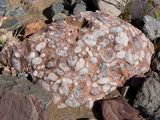
An example of a sedimentary rock, which is, by definition, composed of many, smaller rocks.
Photo courtesy of Alamy Stock Photo
carbonate
adjective, noun
mineral created past the action of carbon dioxide on a base.
clastic sediment
Noun
rock equanimous of fragments of older rocks that have been transported from their place of origin.
detrital rock
Noun
sedimentary rock produced from small pieces of other rocks
dissolution
Noun
termination or destruction by breaking downwards, disrupting, or dispersing
Noun
act in which earth is worn away, often by water, air current, or ice.
geomorphology
Noun
report of geographic features on the mural and the forces that create them.
halite
Noun
natural mineral form of common salt (sodium chloride.) Also called stone salt.
limestone
Substantive
blazon of sedimentary rock mostly made of calcium carbonate from shells and skeletons of marine organisms.
lithify
Verb
to modify into rock or rock.
Noun
all forms in which h2o falls to Earth from the temper.
Noun
solid material transported and deposited past h2o, ice, and current of air.
shale
Substantive
type of sedimentary rock.
stalactite
Noun
rock formed by mineral-rich h2o dripping from the roof of a cave. The water drips, but the mineral remains like an icicle.
stalagmite
Noun
mineral eolith formed on a cave floor, ordinarily by water dripping from above.
Noun
the breaking down or dissolving of the Earth'south surface rocks and minerals.
buckinghamwillithe.blogspot.com
Source: https://www.nationalgeographic.org/encyclopedia/sedimentary-rock/
0 Response to "what is the best way to date a sedimentary rock? choose all that apply."
Post a Comment