Made in India by the Ivory Art Gallery Trivandrum S India
Galleries of
Ivory Carvings
and Scrimshaw
Ivory Portraits and Busts
Ivory Liturgical Combs
Carved Ivory Snuff Bottles
Ivory Mystery Balls
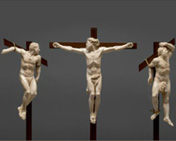
Ivory Crucifixes
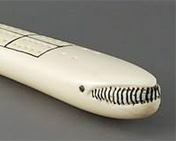
Alaskan Scrimshaw Cribbage Boards
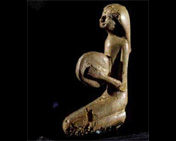
Ancient Ivory
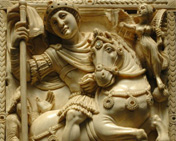
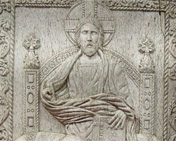
Byzantine Ivory
Medieval Ivory
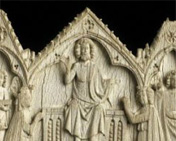
Renaissance Ivory
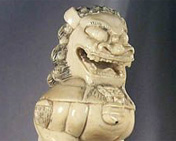
Chinese Ivory
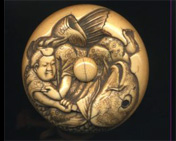
Japanese Ivory
Indian and Near Eastern Ivory
African Ivory
From pre-historic times to the present, ivory has been amongst the nigh prized materials known to human. Sometimes information technology has been brightly-colored, at other times left pure white. Information technology has been used for rough objects to some of the well-nigh intricate and ornamented things e'er created. This gallery will show ivory from the primeval period of history to the present. It volition draw the utilise of ivory in different geographic areas.
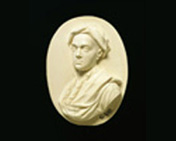
Ivory Portraits and Busts
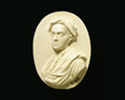
Ivory Portraits and busts were often deputed by royalty and the noble grade in Europe. Ivory workshops in France, England and Frg many numerous masterpieces, from Emperor Augutus (c. 27 BC-xiv Advertizement) to Sir Isaac Newton (1718).
While some portraits were created every bit miniatures, out of a single tusk, others were life-size, made out of multiple tusks and placed upon pedastals of onyx, woods or marble.
Different most ivory carvings, whose carvers remain anonymous, many ivory portraits and busts are signed by their makers. The mojaority of ivory portraits were made from 1600 to 1800.
Ivory portraits and busts are now incredibly valuable and are conserved in the collections of major collections such as the Victoria & Albert Museum and Metropolitan Museum of Art.
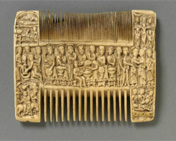
Ivory Liturgical Combs
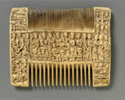
Before combs were cheaply articles in plastic or metal, they were handcrafted out of diverse materials. Ivory combs were made by early civilizations, and were hand carved for centuries around the globe. Some of the earliest combs appointment back 5000 years to Persia. In addition to the standard used of the rummage (i.east. pilus and fiber grooming) combs were also used to brand music. The comb is capable of producing humming sounds when used like a harmonica, and thumb pianoforte sounds, when strummed with fingers.
Ancient ivory combs were oftentimes double sided. While one side would have smaller, thinner tines and the other side would have larger, stronger ones. The surface are of the ivory would often portray religious scenes, or intricate floral patterns.
Ivory liturgical combs are now extremely valuable artifacts, boasted past collectors of medieval and ancient art.
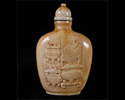
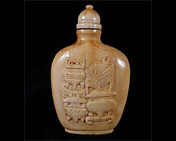
Carved Ivory Snuff Bottles
Ivory Snuff Bottles were widely utilized in China during the Qing Dynasty (1644-1912). At this time smoking tobacco was prohibited, which led to the rise in popularity of snuff, a powdered class of tobacco. Past the 18th century, snuff was used among all social classes in China, though the blazon of snuff bottle remained an indicator of wealth and stature.
Snuff bottles were made out of jade, trounce, glass, porcelain, forest, ceramic and ivory. The ivory snuff bottles were often carved or painted with narrative scenes or ornate designs. The ivory snuff bottles are almost always carved out of elephant tusk. The tops of the bottles are attached to a small-scale spoon, used to apply the snuff.
In 16th century Europe, snuff consumers used a similar, box-shaped vessel to store their snuff. These boxes, similar the snuff bottles, became status symbols for the borgious to show off to their friends.
Replicas of snuff bottles are nevertheless fabricated, and original antiquarian bottles continue to increment in value.
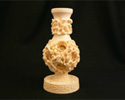
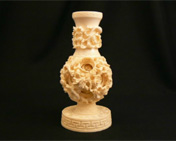
Ivory Mystery Balls / Chinese Puzzle Balls
Intricately carved mystery assurance (likewise called Chinese puzzle balls) have been carved since ancient times. The balls consist of concentrically carved spheres that vary in size and number. Each sphere contains a windowed blueprint, revealing the complexity of the inner spheres. While antique ivory mystery balls are amongst the most precious, other versions have been carved out of jade, soapstone, wood and "Hong Kong Ivory" (a synthetic ivory created out of ground and compressed bone). Antique ivory versions were often accompanied by a carved pedestal, which served to hold and display each mystery ball.
Traditional Chinese mystery balls were carved with a variety of patterns, including dragons, phoenix, bloom, peach blossoms and birds. The number of layers normally runs betwixt iii and seven, but has reached upwards to forty-two layers.
The process of making a mystery brawl is quite complex and begins with turning a solid ball on a lathe. The ball is and then drilled into and reworked with numerous hand-tools. The two strongest, outermost balls are oftentimes fused together to prevent the more frail inner assurance from breaking.
Mystery balls continue to be made in modern times, but are mainly made out of synthetic, imitation ivory.
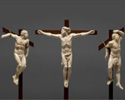
Ivory Crucifixes
Antique ivory crucifixes were carved in various styles and sizes. The crucifix, consisting of a representation of Jesus's trunk adhered to a cross, is mostly used in the Roman Catholic, Anglican, Lutheran and Eastern Orthodox churches. In some versions both the cross and corpus are carved from ivory, while in other versions only the corpus is ivory and the cantankerous is wood or metal.
Modest-scale ivory crucifixes were easily carved from a unmarried piece of ivory, where larger ivory crucifixes were fabricated from multiple pieces. Smaller crucifixes are used as pendant, rosaries, or to adorn interior effects. Larger ivory crucifixes are seen in church altars, and now museum collections. The larger ivory pieces are often partially painted or carry a Latin inscription.
Ivory crucifixes are mostly normally establish in Europe and the Americas, only versions of the ivory crucifix tin be found all over the world.
In modern times, crucifixes are made out of wood, metallic or synthetic materials, making antiquarian ivory crucifixes especially valuable.
Alaskan Scrimshaw Cribbage Boards
English colonists brought cribbage to Northward America during their settlement. The game somewhen made its manner to Alaska, where the art of scrimshaw and cribbage boards collided.
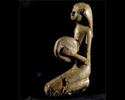
Ancient Ivory
From the Upper Paleolithic menses (fifty,000 - 10,000 B.C.) in Europe to the establishment of Byzantium of the new of Rome in A.D. 330, ivory religious and luxury objects were created and traded throughout antiquity.
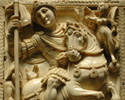
Byzantine Ivory
After Byzantium supplanted Rome equally the upper-case letter of the Empire, the Byzantine style of ivory etching gained popularity in the western portion of the Empire. The Byzantine aesthetic developed until the capital-now called Constantinople-was captured by the Turks in 1453.
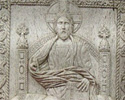
Medieval Ivory
In 726, Eastern Roman Emperor Leo 3, enacted a law banning the creation of religious images, known as icons. He ordered the removal of the relief of Christ at the entrance to the imperial palace and its replacement with a cross inscribed "I drive out the enemies and kill the barbarians." Ivory craftsmen left the Eastern Roman Empire and moved westward. With the investiture of Charlemagne in 800 as Holy Roman Emperor, ivory etching returned to a identify of prominence in Northern Europe. Important ivory workshops arose particularly in England, French republic, Federal republic of germany, and Belgium.
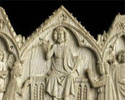
Renaissance Ivory
The Renaissance was the start era during which people were so cocky-conscious that they came upward with a name for the era through which they were living. The word "renaissance" means re-birth. To the Renaissance person, act was responsible for the grade of history. It was a time of unparalleled creativity in all the arts and crafts. At that place was a loftier degree of skill in the ivories of this period, which were strongly influenced by the Greek and Roman classics.
Chinese Ivory
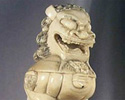
The earliest ivory institute in China dates from the Neolithic period (ca. 5000 B.C.). More ivories have been institute from the pre-Ming period (ca.1600 B.C. - A.D. 1368), though they are not every bit numerous as jade or bone carvings. The majority of the Chinese ivory nosotros have dates from the Ming (1368-1644 A.D.) or Qing (1644-1911 A.D.) dynasties. Beginning in the Sixteenth Century, Portuguese traders and missionaries had contact with the Chinese. The western market had a profound effect on ivory carving. By the late Sixteenth Century, a large percentage of the religious figures in Espana, for instance, were fashioned in China. Ivory worked for the domestic Chinese market were of equally high quality.
Japanese Ivory
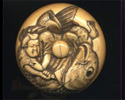
Many of the primeval Japanese ivories are securely indebted to Chinese prototypes. Ivory during the early period was more often than not used for inlay and is washed in long-established styles. The aboriginal traditions of Nihon were threatened by the arrival of Portuguese, Dutch, and British missionaries and traders in the showtime of the Sixteenth Century. Christianity was banned and foreign influence was driven hole-and-corner. In the Eighteenth Century, netsuke brainstorm to appear. These Japanese ivory carvings are highly-prized throughout the world. They were used to open up and close the small boxes (inro) worn underneath kimonos by both women and men. In the Nineteenth and Twentieth Centuries, the delicately-carved ivory netsuke with mannerly themes have gained international popularity.

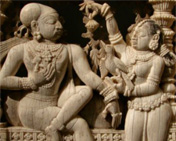
Indian and Near Eastern Ivory
Important ivories accept been recovered from the Virtually East and Republic of india from the nigh ancient archaeological sites. From the Sixteenth Century A.D., ivory was used extensively in Republic of india. With the availability of native ivory, and the tradition of highly skilled craftsmen, ivory from the swell carving centers in Orissa, Madras, Ceylon (now Sri Lanka) and the Portuguese colony Goa, were highly-desired luxury items throughout the world.
The motifs of artifact were retained and refined in the Almost Due east after the advent of Islam in A.D. 622. Chess pieces were the about popular use of ivory in the Near East during the 7th, Eighth, and Ninth Centuries. Carved elephant tusks, called oliphants, were carved in Syria, Egypt, Mesopotamia, and other parts of the Islamic earth during the Eleventh, 12th, and early Thirteenth Centuries. Christian European leaders prized them every bit symbols of feudal authorisation. European collectors in more modern times have cherished the meticulous and elaborately-carved ivory from Egypt, Istanbul, and other parts of the Nearly E.
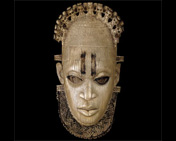
African Ivory
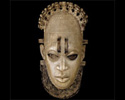
In most African cultures ivory was an indicator of wealth. High-status Ibo women, for example, wore massive ivory pieces as a mark of their place in the social and economical bureaucracy. Ivory was valued similarly in African and European cultures.
Ivory objects were some of the first worked materials shipped to Europe from Africa when explorers started traveling through Africa in the Fifteenth Century. The "Afro-Portuguese" carvings of luxury items were amongst the most accomplished ivory carving of the Sixteenth, Seventeenth and Eighteenth Century. Nineteenth and Twentieth Century ivory carved for the domestic African market are highly-regarded both for their pattern and the quality of their craftsmanship.
buckinghamwillithe.blogspot.com
Source: https://www.ivoryexperts.com/gallery.html
0 Response to "Made in India by the Ivory Art Gallery Trivandrum S India"
Post a Comment